 Image search results - "existence" Image search results - "existence" |

05_Abhidhamma.mp3Intermediate Existence in the Suttas1175 viewsEnquiring into the origins, purpose and limitations of the Abhidhamma.
|
|
13_Abhidhamma.mp3Why is non-human existence not recollected in past life regression?958 viewsQuestions and Answer with Ven. Aysama Aggacitta.
|
|

4sublime_states.pdfThe Four Sublime States6174 viewsVen. Nyanaponika Thera
Four sublime states of mind have been taught by the Buddha: Loving-kindness (metta), Compassion (karuna), Sympathetic Joy (mudita), Equanimity (upekkha) These four attitudes are said to be excellent or sublime because they are the right or ideal way of conduct towards living beings They provide, in fact, the answer to all situations arising from social contact. They are the great removers of tension, the great peacemakers in social conflict, and the great healers of wounds suffered in the struggle of existence. They level social barriers, build harmonious communities, awaken slumbering magnanimity long forgotten, revive joy and hope long abandoned, and promote human brotherhood against the forces of egotism.
|
|
advice.pdfAdvice for Monks and Nuns2981 viewsThe continued existence of the Buddha Dharma depends upon the continued existence of the Sangha - the community of ordained practitioners, monks and nuns - one of the three Buddhist Refuges. In these talks, Lama Yeshe and Lama Zopa Rinpoche explain the great benefits of practicing Dharma as an ordained person, how to keep the ordination pure, the purpose of the monastic community, how to live together as monks and nuns, and much more. The necessity for the lay community to support the Sangha is also made clear, and not only monks and nuns but lay practitioners, too, will gain much by reading this book.
|
|
allexistence.pdfThe 31 Planes of Existence4906 viewsThe suttas describe the 31 distinct planes or realms of existence into which beings can be reborn during their long wanderings through samsara. These range from the extraordinarily dark, grim, and painful hell realms all the way up to the most sublime, refined and exquisitely blissful heavenly realms. Existence in every realm is impermanent; in the cosmology taught by the Buddha there is no eternal heaven or hell. Beings are born into a particular realm according to both their past kamma.
|
|
BT03A.MP3Lecture 3. (a) The True Nature of Existence3380 viewsThe lectures explain the Dhamma from the perspective of Theravada Buddhism, the oldest continuous Buddhist school, whose scriptures, the Pali canon, give the most accurate picture of what the historical Buddha himself actually taught. The lectures are intended to be basic enough to be of value to beginners without previous study of the Dhamma, and deep and through enough to be of interest to long-term students seeking to extend and clarify their understanding.
|
|
BT03B.MP3Lecture 3. (a) The True Nature of Existence2813 viewsThe lectures explain the Dhamma from the perspective of Theravada Buddhism, the oldest continuous Buddhist school, whose scriptures, the Pali canon, give the most accurate picture of what the historical Buddha himself actually taught. The lectures are intended to be basic enough to be of value to beginners without previous study of the Dhamma, and deep and through enough to be of interest to long-term students seeking to extend and clarify their understanding.
|
|
chanmed1.pdfFundamentals of Ch'an Meditation Practice7083 viewsTing Chen, Tr. Master Lok To
The Fundamentals of (Ch'an) Meditation Practice by Ting Chen. Originally, one's own mind and nature are pure, and there is nothing to accept and nothing to refuse; there is neither existence nor nonexistence; there is only clear understanding without attachment and with no dwelling. One who wants to know the no-attachment, no-dwelling mind can find it through meditation, because it is only then that the mind does not think of right and wrong, of good and evil or of self and others.
|
|
dietolive.pdfDying to Live3203 viewsThere are different views and beliefs about what happens after death. Tibetan (Vajrayana) and Chinese (Mahayana) Buddhists believe that after death, the spirit of the dead person passes through an intermediate period (bardo in Tibetan, zhong yin in Mandarin)- which may last for as long as forty-nine days - during which it undergoes a series of unearthly, extraordinary experiences, including a "small death" at the end of each week, before it is finally reborn into another realm of existence. In contrast, orthodox Theravada Buddhism, which is the earliest extant record of Gotama Buddha's teaching, asserts that rebirth takes place immediately after death.
|
|
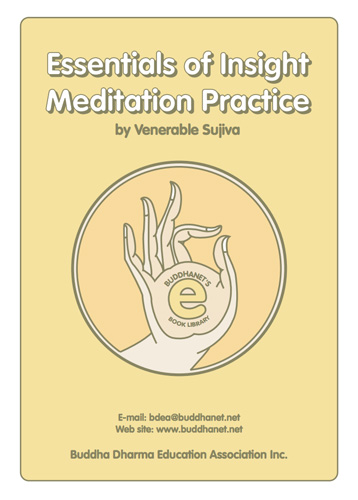
essentials.pdfEssentials of Insight Meditation Practice7771 viewsThe ultimate aim of insight meditation is to free one from the unsatisfactoriness of cyclic existence. Readers may also find numerous quotations of the Buddha's teaching on mindfulness, detachment and liberation throughout the entire book. Those verses act as a source of inspiration and purpose to put vipassana into practice - a practice that brings about insight into the three universal characteristics of unsatisfactoriness, impermanence and non-self which leads one into detachment and ultimate liberation.
|
|
|
|





















 Social Bookmarks


