 Image search results - "language," Image search results - "language," |

3_teach.pdfThree Teachings8106 viewsTenzin Palmo's Teachings on Retreat, Mahamudra and Mindfulness are a delight to read. Transcribed from talks she gave in Singapore in May 1999, the teachings are delivered in plain language, seasoned with plenty of audience participation. Each subject is discussed with humour, liveliness and compassion. She has the great gift of showing how to put the Dharma into every part of our everyday lives. Born in London in 1993, Tenzin Palmo traveled to India and was ordained as a Buddhist nun in 1964. Her 12-year retreat in a cave high in the Himalayas, described in the book 'Cave in the Snow', focused international attention on the role of women and their spirituality in the Buddhist context.
|
|
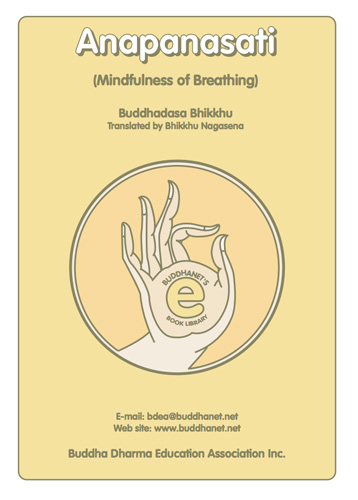
anapanasati.pdfAnapanasati - Mindfulness of Breathing13924 viewsFor the first time in the English language a comprehensive manual of Buddhist meditation known as anapanasati (the development of mindfulness of breathing) is available. Although this manual is primarily intended for the benefit of monks, it will greatly assist laymen, too, who wish to undertake a course of meditation but who do not have the guidance of a teacher. Originally published in Thai, this manual is one of the major works of the Ven. Buddhadsa Bhikkhu and delivered in 1959 in the form of a series of lectures to monks of Suanmokkha Monastery, Chaiya, Thailand. Ven. Buddhadasa Bhikkhu, a major voice in the Buddhist world, is an accepted master of Buddhist meditation. In constructive positive language, the manual guides the meditator through the 16 steps of anapanasati.
|
|
Nagarjuna-upaya.pdfNÄgÄrjuna and the Philosophy of UpÄya 2573 viewsThe purpose of this article is to offer a different account of NÄgÄrjuna than is found in contemporary Western scholarship. It will not ask what it means for causality, truth, the self, or consciousness to be "empty" in a very general sense, but rather how NÄgÄrjuna’s philosophy relates to the soteriological practices of Buddhism and what it means for those practices to be "empty" of inherent nature. Rather than describing NÄgÄrjuna as a metaphysician this study will situate him squarely within the early MahÄyÄna tradition and the philosophical problem of practice that is expressed through the doctrine of “skill-in-means†(upÄya-kauÅ›alya). It should become evident in what follows that the doctrine of upÄya has little in common with Western metaphysics. It is unconcerned with problems regarding causality, personal identity, consciousness, logic, language, or any other issues that are unrelated to specific problems surrounding the nature and efficacy of Buddhist practice. Given that every major tradition in Buddhism stresses the indispensable nature of practice, it is highly unlikely that Nagarjuna’s philosophy is concerned with metaphysical issues or that his doctrine of “emptiness†can be separated from the soteriological practices of Buddhism.
|
|
scrndhamma.pdfThe Dhammapada, by Acharya Buddharakkhita3470 viewsVen. Acharya Buddharakkita
Translated from the Pali by Acharya Buddharakkhita and with an introduction by Bhikkhu Bodhi. The Dhammapada is the best known and most widely esteemed text in the Pali Tipitaka, the sacred scriptures of Theravada Buddhism. The work is included in the Khuddaka Nikaya (Minor Collection) of the Sutta Pitaka, but its popularity has raised it far above the single niche it occupies in the scriptures to the ranks of a world religious classic. Composed in the ancient Pali language, this slim anthology of verses constitutes a perfect compendium of the Buddha's teaching, comprising between its covers all the essential principles elaborated at length in the forty-odd volumes of the Pali Canon.
|
|
|
|




















 Social Bookmarks


