 Image search results - "major" Image search results - "major" |
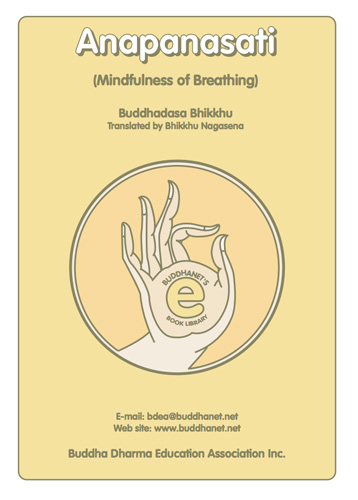
anapanasati.pdfAnapanasati - Mindfulness of Breathing13908 viewsFor the first time in the English language a comprehensive manual of Buddhist meditation known as anapanasati (the development of mindfulness of breathing) is available. Although this manual is primarily intended for the benefit of monks, it will greatly assist laymen, too, who wish to undertake a course of meditation but who do not have the guidance of a teacher. Originally published in Thai, this manual is one of the major works of the Ven. Buddhadsa Bhikkhu and delivered in 1959 in the form of a series of lectures to monks of Suanmokkha Monastery, Chaiya, Thailand. Ven. Buddhadasa Bhikkhu, a major voice in the Buddhist world, is an accepted master of Buddhist meditation. In constructive positive language, the manual guides the meditator through the 16 steps of anapanasati.
|
|

Arahattamagga.pdfArahattamagga, Arahattaphala: The Path to Arahantship4767 viewsAt present, all that is left of Buddhism are the words of the Buddha. Only his teachings ñ the scriptures ñ remain. Please be aware of this. Due to the corruption caused by the defiling nature of the kilesas, true spiritual principles are no longer practiced in present-day Buddhism. As Buddhists, we constantly allow our minds to be agitated and confused, engulfed in mental defilements that assail us from every direction. They so overpower our minds that we never rise above these contaminating influences, no matter how hard we try. The vast majority of people are not even interested enough to try: They simply close their eyes and allow the onslaught to overwhelm them. They don't even attempt to put up the least amount of resistance. Since they lack the mindfulness needed to pay attention to the consequences of their thoughts, all their thinking and all they do and say are instances of the kilesas giving them a beating. They surrendered to the power of these ruinous forces such a long time ago that they now lack any motivation to restrain their wayward thoughts...
|
|
ctp_screen-view-v1.pdfClearing the Path2781 viewsNOTE: There are 3 versions of Clearing the Path. This version is made for screen viewing and is very similar to the book version. However it is not designed to be printed because the pages are not a standard size (the pages have been cropped for easier screen viewing). It cannot be expected that this material, which poses a clear challenge to the mainstream version of Buddhism, will gain any great popularity among the majority of Buddhists - Eastern or Western - but at least it can suggest an alternative approach to the Buddha's original Teaching, and perhaps serve as a useful eye-opener for those seeking an understanding of its more fundamental principles.
|
|

File10_(AM)_Contemplating_the_thought-stream.mp3Contemplating the Thought-stream1634 viewsPatrick Kearney's Vipassana Retreat Talk at Bodhi Tree Monastery (2009)
Our addiction to thinking creates a major barrier to settling into Samadhi, “unification†or “concentration.†Often we try to push thought away, or simply endure it as an unpleasant fact of life. But the essence of this practice, according to Mahasi Sayadaw, is to note, or be deliberately aware of, whatever is predominant in any of the six sense fields, now. If thinking is currently predominant, then thinking should be our meditation
|
|
First_Discourse-Comparison_of_Versions.pdfThe Buddha's First Discourse: a Comparision of Versions2726 viewsThis is a study of the Dhammacakka-Pavattana-Sutta, officially considered the first discourse of the Buddha. The tradition acknowledges that he spoke about his teaching before the occasion of the delivery of this discourse. This study was undertaken during my Buddhist studies, which was one major of my Batchelor of Arts at the University of Queensland, completed in 2004. The study compares 17 possible versions of this discourse from four languages: Pali, Chinese, Tibetan and Sanskrit. Some interesting differences are discovered and an attempt is made to explain them. An expected core of all the discourses stands out, which shows why all major schools of Buddhism accept the Four Noble Truths as the essential teaching of the Buddha.
|
|
honourfathers.pdfHonor Our Fathers1610 viewsThis book is intended primarily as a tribute to the late Venerable Kapilavaddho Bhikkhu (William August Purfurst, known later as Richard Randall) for whom the English Sangha Trust was formed. He stands out as a man who started and developed the founding of the first English Theravada Sangha in the Western world. For the sake of context it includes a very brief history of the development of Theravada Buddhism in the UK. Only the major steps of this development have been recorded here, though many other groups have contributed to the spreading of Buddhism in the UK.
|
|
Illuminating_Path_Enlightenment.pdfIlluminating the Path to Enlightenment4015 viewsIn this book, His Holiness the Dalai Lama gives a commentary to not only Atisha's revolutionary work but also to Lines of Experience, a short text written by Lama Tsong Khapa, who was perhaps the greatest of all Tibetan lam-rim authors. In bringing together Atisha, Lama Tsong Khapa and His Holiness the Dalai Lama, this book offers readers one of the clearest and most authoritative expositions of the Tibetan Buddhist path ever published, and it is recommended for those at the beginning of the path, the middle and the end. This is the first time a major teaching by the Dalai Lama has been published for free distribution.
|
|
Nagarjuna-upaya.pdfNÄgÄrjuna and the Philosophy of UpÄya 2561 viewsThe purpose of this article is to offer a different account of NÄgÄrjuna than is found in contemporary Western scholarship. It will not ask what it means for causality, truth, the self, or consciousness to be "empty" in a very general sense, but rather how NÄgÄrjuna’s philosophy relates to the soteriological practices of Buddhism and what it means for those practices to be "empty" of inherent nature. Rather than describing NÄgÄrjuna as a metaphysician this study will situate him squarely within the early MahÄyÄna tradition and the philosophical problem of practice that is expressed through the doctrine of “skill-in-means†(upÄya-kauÅ›alya). It should become evident in what follows that the doctrine of upÄya has little in common with Western metaphysics. It is unconcerned with problems regarding causality, personal identity, consciousness, logic, language, or any other issues that are unrelated to specific problems surrounding the nature and efficacy of Buddhist practice. Given that every major tradition in Buddhism stresses the indispensable nature of practice, it is highly unlikely that Nagarjuna’s philosophy is concerned with metaphysical issues or that his doctrine of “emptiness†can be separated from the soteriological practices of Buddhism.
|
|
paradoxofbecoming.pdfThe Paradox of Becoming1450 viewsThe topic of becoming, although it features one major paradox, contains other paradoxes as well. Not the least of these is the fact that, although becoming is one of the most important concepts in the Buddha’s teachings, there is no full-scale treatment of it in the English language. This book is an attempt to fill that lack.
The importance of becoming is evident from the role it plays in the Four Noble Truths, particularly in the second: Suffering and stress are caused by any form of craving that leads to becoming. Thus the end of suffering must involve the end of becoming.
|
|
pureland.pdfPure Land Buddhism3653 viewsThis book presents the teachings and major tenets of the Pure Land school of Buddhism,as seen from the perspective of two major sister schools: Zen and Taien Taai (Lotus School). Further insights,from the viewpoint of a contemporary Pure Land Master are included in the Appendix. The principal teachings of the Pure Land School are summarized for the benefit of readers.
|
|
|
|





















 Social Bookmarks


