 Image search results - "mun" Image search results - "mun" |

01_Inspiration.mp31. Golden Chain Of Love (Songs)2484 viewsThe Buddha is the greatest role model in the history of mankind. As the Exalted One, His boundless love is in comparable to any other. He is the All-knowing One with the ability to communicate even the most complex concept in the universe into simple and easily understood phrases. Endowed with knowledge and virtue, the Buddha reminds us to against perpetrating any unwholesome deeds and encourages us to perform wholesome deeds. With firm morals, the mind can then be set free from all forms of distractions.
|
|

04_anapanasati_sutta.pdfThe Anapanasati Sutta4583 viewsThe Anapanasati Sutta is not an easy read, although the language itself is quite simple. But its structure is complex and dense, and this complexity raises serious questions about interpretation. The complexity of the structure creates ambiguity. Even the orthodox commentary sees certain passages as capable of different but simultaneous readings, referring to either serenity or insight practice depending on what approach to the practice the practitioner is taking.
We can see how Thich Nhat Hanh can take liberties with the text, but he does so to make the practice explained within it more accessible to ordinary lay people. Are we to assume that this was not the intention of the original compilers? Or can we see the complexity of the sutta as evidence of an attempt to create a discourse that different communities of practitioners could, quite legitimately, read in different ways? In any event, if we are to make sense of this sutta, and extract from it what it has to offer in terms of guidance on the practice, we need to read the structure of the text. It is not just the surface words that convey meaning, but the underlying networks that link the words.
|
|
05_satipatthana_sutta_01.pdf01 Satipatthana Sutta3697 viewsWe have seen how different approaches to translation provide different approaches to the meditation practice itself. Translation, interpretation and practice all take place within communities. One's choices in translation is also an expression of one's identity. If I identify with a specific tradition, I will translate in a way that fits with that tradition's view of the teaching and the practice. If I refuse to identify with a tradition, preferring to go my own way or be part of the creation of a new tradition, this choice also will condition translation and interpretation. And interpretation conditions practice. The practice is defined by its texts, and the texts are formed by translation and interpretation.
|
|
06_satipatthana_sutta_02.pdf02 Satipatthana Sutta3014 viewsDuring this course we have looked at how different interpretative communities read the Nikayas. Among these are contemporary communities formed by the experience of modernity, practitioners who are attempting to apply the teachings found in the Nikayas to their daily lives in the contemporary world. Locating ourselves within such a community, we can see that our reading is a form of practitioner criticism. We have sought to make sense of this alien literature firstly by acknowledging that it is not a literature at all, but a collection of oral performances. We have examined how these performances are both made up of and linked by patterns of repetition lists of lists within lists. The lists function like tables in individual databases, and the teaching as a whole - the dhamma - functions as a relational database which exists, not within any given sutta, but as a network of relationships which underlies and unites all the suttas.
|
|
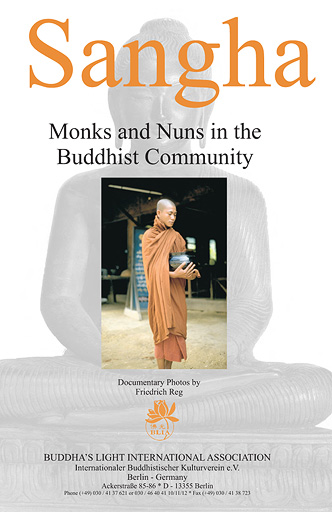
0_The_Sangha_-_Photos_by_Friedrich_Reg.pdfThe Sangha - Monks and Nuns in the Buddhist Community2428 viewsDocumentary Photos by Friedrich Reg
Collected into a single PDF with descriptions in multiple languages.
|
|
4sublime_states.pdfThe Four Sublime States6179 viewsVen. Nyanaponika Thera
Four sublime states of mind have been taught by the Buddha: Loving-kindness (metta), Compassion (karuna), Sympathetic Joy (mudita), Equanimity (upekkha) These four attitudes are said to be excellent or sublime because they are the right or ideal way of conduct towards living beings They provide, in fact, the answer to all situations arising from social contact. They are the great removers of tension, the great peacemakers in social conflict, and the great healers of wounds suffered in the struggle of existence. They level social barriers, build harmonious communities, awaken slumbering magnanimity long forgotten, revive joy and hope long abandoned, and promote human brotherhood against the forces of egotism.
|
|
acariya-mun-bio.pdfAcariya Mun Bhuridatta - A Spiritual Biography (with Photographs)2015 viewsA Spiritual Biography by Acariya Maha Boowa Nanasampanno. Translated from the Thai by Bhikkhu Dick Salaratano. Acariya Mun Bharidatta Thera was a vipassana meditation master of the highest caliber of this present age. He taught the profound nature of Dhamma with such authority and persuasion that he left no doubts among his students about the exalted level of his spiritual attainment. His devoted followers consist of numerous monks and laity from virtually every region of Thailand. His story is truly a magnificent one throughout: from his early years in lay life through his long endeavor as a Buddhist monk to the day he finally passed away.
This copy is a high quality screen version of the original eBook
|
|
acariya-mun.pdfAcariya Mun Bhuridatta - A Spiritual Biography (Screen Version)1853 viewsA Spiritual Biography by Acariya Maha Boowa Nanasampanno. Translated from the Thai by Bhikkhu Dick Salaratano. Acariya Mun Bharidatta Thera was a vipassana meditation master of the highest caliber of this present age. He taught the profound nature of Dhamma with such authority and persuasion that he left no doubts among his students about the exalted level of his spiritual attainment. His devoted followers consist of numerous monks and laity from virtually every region of Thailand. His story is truly a magnificent one throughout: from his early years in lay life through his long endeavor as a Buddhist monk to the day he finally passed away.
|
|
advice.pdfAdvice for Monks and Nuns2982 viewsThe continued existence of the Buddha Dharma depends upon the continued existence of the Sangha - the community of ordained practitioners, monks and nuns - one of the three Buddhist Refuges. In these talks, Lama Yeshe and Lama Zopa Rinpoche explain the great benefits of practicing Dharma as an ordained person, how to keep the ordination pure, the purpose of the monastic community, how to live together as monks and nuns, and much more. The necessity for the lay community to support the Sangha is also made clear, and not only monks and nuns but lay practitioners, too, will gain much by reading this book.
|
|
ancientsgrfx.pdfPopular Deities of Chinese Buddhism4214 viewsThis elementary book on Chinese Buddhism and its more popularly worshipped Deities, has been written for the benefit of Buddhists amongst the Chinese community. Apart from giving a general outline of Buddhism and its entry into China, I have also attempted to provide brief accounts on the important doctrines that the Buddha has taught, prayers that one may recite to the Buddhas and Bodhisattvas, how to become a Buddhist, and a number of interesting articles that are related to Chinese Buddhism - Kuan Ming.
|
|
| 119 files on 12 page(s) |
1 |
 |
|
|
|
|
|
|



















 Social Bookmarks


