 Image search results - "practices" Image search results - "practices" |

03_texts_and_practices.pdfTexts and Practices3476 views
The Suttas are chants, and are full of repetitions. When we look at the patterns of repetitions we discover something quite familiar to us: verses and chorus. Let us take some path text and use it to illustrate the problem we are talking about, and suggest another way of reading these texts that takes into account their oral structure as outlined above: Atthakanagara Sutta (M52) and Culasunnata Sutta: Smaller discourse on emptiness (M121)
|
|

06_Minds-latent-tendencies.mp3(6) The Mind's Latent Tendencies2812 viewsHere we are dealing with the mind's unwholesome predispositions and how to work with them from the point of view of meditation practices, epsecially Vipassana meditation.
|
|
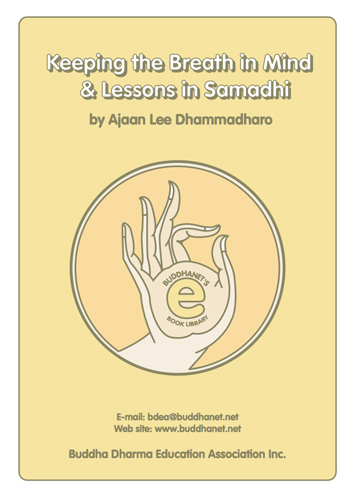
breathmind.pdfKeeping the Breath in Mind & Lessons in Samadhi8081 viewsThis is a 'how to' book. It teaches the liberation of the mind, not as a mind-boggling theory, but as a very basic skill that starts with keeping the breath in mind. The teachings here are drawn from the works of Ajaan Lee Dhammadharo (1906-61), one of Thailand's most renowned teachers of Buddhist meditation practices. Ajaan Lee was a forest monk - one who prefers to live in the seclusion of the forest and makes his meditation the central theme of his practice - so his teachings grow out of personal, practical experience, although he also makes a point of relating them to standard Buddhist doctrine.
|
|
buddhistway.pdfThe Buddhist Way7432 viewsDr K. Sri Dhammananda explains some Buddhist cultural practices: Going for Refuges, Religious Rites, Alms Giving, Marriage, Buddhist Education and Cultural Practices, Images, Holy Water, Holy Thread, Talismans and Amulets, Blessing Services for Children, Death, Post Mortem, Funerals, Burial and Cremation, Disposal of the Ashes, Period of Mourning, Post-Funeral Rites and Memorial Services.
|
|
into_the_stream.pdfInto the Stream: A Study Guide On The First Stage Of Awakening1671 viewsThe Pali Canon recognizes four levels of Awakening, the first of which is called stream entry. This gains its name from the fact that a person who has attained this level has entered the “stream†flowing inevitably to Nibbana. He/she is guaranteed to achieve full awakening within seven lifetimes at most, and in the interim will not be reborn in any of the lower realms.
This study guide on stream entry is divided into two parts. The first deals with the practices leading to stream entry; the second, with the experience of stream entry and its results.
|
|
kathina.pdfKathina: Then and Now2174 viewsThe kathina ceremony is now an internationally established celebration where the Sangha and the laity meet to participate in mutually rewarding, meritorious activities. Throughout the centuries, the way of carrying out the ceremony has changed with local interpretations, practices and customs. How much has deviated from the original scriptural tradition - how much is in accordance with the scriptures and how much is mere invention? In this booklet, Venerable Aggacitta Bhikkhu combines his scriptural knowledge and practical experience to scrutinise the kathina ceremony through two articles: The Scriptural Tradition of Kathina; Kathina Benefits - Illusion, Delusion and Resolution.
|
|
Nagarjuna-upaya.pdfNÄgÄrjuna and the Philosophy of UpÄya 2561 viewsThe purpose of this article is to offer a different account of NÄgÄrjuna than is found in contemporary Western scholarship. It will not ask what it means for causality, truth, the self, or consciousness to be "empty" in a very general sense, but rather how NÄgÄrjuna’s philosophy relates to the soteriological practices of Buddhism and what it means for those practices to be "empty" of inherent nature. Rather than describing NÄgÄrjuna as a metaphysician this study will situate him squarely within the early MahÄyÄna tradition and the philosophical problem of practice that is expressed through the doctrine of “skill-in-means†(upÄya-kauÅ›alya). It should become evident in what follows that the doctrine of upÄya has little in common with Western metaphysics. It is unconcerned with problems regarding causality, personal identity, consciousness, logic, language, or any other issues that are unrelated to specific problems surrounding the nature and efficacy of Buddhist practice. Given that every major tradition in Buddhism stresses the indispensable nature of practice, it is highly unlikely that Nagarjuna’s philosophy is concerned with metaphysical issues or that his doctrine of “emptiness†can be separated from the soteriological practices of Buddhism.
|
|
Nagarjuna.pdfNÄgÄrjuna and the Philosophy of UpÄya2600 viewsThe purpose of this article is to offer a different account of Nagarjuna than is found in contemporary Western scholarship. It will not ask what it means for causality, truth, the self, or consciousness to be "empty" in a very general sense, but rather how NÄgÄrjuna's philosophy relates to the soteriological practices of Buddhism and what it means for those practices to be "empty" of inherent nature. Rather than describing NÄgÄrjuna as a metaphysician this study will situate him squarely within the early Mahayana tradition and the philosophical problem of practice that is expressed through the doctrine of “skill-in-means†(upÄya-kausalya).
|
|
noblestrategy.pdfNoble Strategy: Essays of the Buddhist Path1495 viewsThe essays in this book present views on basic elements in the Buddhist path—the attitudes, concepts, and practices that lead to total freedom for the mind. If the views are right, they themselves form a part of the path. Thus, in learning how to make best use of these essays, it’s important to understand how views function in bringing about freedom.
|
|
Path_of_Purification_Visuddhimagga.pdfVisuddhimagga / The Path of Purification2798 viewsThis book is "The Classic Manual of Buddhist Doctrine and Meditation". Written by Buddhaghosa in the Fifth Century in Sri Lanka, and known by its Pali title, Visuddhimagga, it is the fundamental manual for the Theravadin school of Buddhism, upon which the popular Vipassana meditation is based. But it is ever so much more than merely a Vipassana manual. Divided into three main sections covering the three "baskets" of Buddha's teaching, it first addresses Virtue (Sila) and a brief chapter on acceptable ascetic practices. Next there follows a large and wonderful section on training in Concentration (Samadhi) based on the forty traditional meditation subjects. Finally, it concludes with a large section on Understanding (Panna), the wisdom teachings of the Abhidhamma.
|
|
|
|





















 Social Bookmarks


