 Image search results - "sanskrit" Image search results - "sanskrit" |
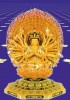
Avalokiteshvara001.jpgAvalokiteshvara Bodhisattva2385 viewsThe Bodhisattva of Great Compassion
The Sanskrit name "Avalokiteshvara" means "the lord who looks upon the world with compassion".
Translated into Chinese, the name is "Kuan Shih Yin"or Quan Yin.
|
|

chandew.pdfThe Sweet Dews of Ch'an5819 viewsReverend Cheng Kuan
Ch'an or Zen is the outcome of meditation. There are two 'right'or 'highest' purposes of Ch'an. The first purpose is to achieve Dhyana. Dhyana is a combination of relaxation, concentration and calmness or tranquility. The second purpose is, using your very composed and tranquil mind, to observe clearly all the dharmas or phenomena externally and internally. As an outcome of Dhyana, you will be able to observe these phenomena very clearly because your mental mirror is very clear, for there are no more disturbances to veil it. Out of these observations will come Transcendental Wisdom, which in Sanskrit is called Prajna.
|
|
First_Discourse-Comparison_of_Versions.pdfThe Buddha's First Discourse: a Comparision of Versions2726 viewsThis is a study of the Dhammacakka-Pavattana-Sutta, officially considered the first discourse of the Buddha. The tradition acknowledges that he spoke about his teaching before the occasion of the delivery of this discourse. This study was undertaken during my Buddhist studies, which was one major of my Batchelor of Arts at the University of Queensland, completed in 2004. The study compares 17 possible versions of this discourse from four languages: Pali, Chinese, Tibetan and Sanskrit. Some interesting differences are discovered and an attempt is made to explain them. An expected core of all the discourses stands out, which shows why all major schools of Buddhism accept the Four Noble Truths as the essential teaching of the Buddha.
|
|
heart_s2.pdfThe Prajna Paramita Heart Sutra11120 viewsThe Prajna Paramita Heart Sutra Translated from Sanskrit into Chinese by Tripitaka Master Hsuan Tsang Commentary by Grand Master T'an Hsu Translated into English by Ven. Dharma Master Lok To. The Prajna Paramita Hrydaya Sutra is the core of the Maha Prajna Paramita in six hundred scrolls. This book is based on a nine-day teaching in which Grand Master T'an Hsu went through the sutra line by line, giving a clear and extensive commentary on each one, using many carefully chosen examples along the way to make his discourse more relevant in terms of everyday life. [French Sutra Translation Committee of the United States and Canada New York - San Francisco - Toronto 2000. First published 1995. Second Edition 2000. Sutra Translation Committee of the United States and Canada].
|
|

Ksitigarbha01.jpgKsitigarbha Bodhisattva012708 viewsTi Tsang P'usa: Ksitigarbha Bodhisattva
Ti Tsang P'usa is an extremely popular Bodhisattva among the Chinese and Japanese Buddhists. 'Ti Tsang', meaning 'Earth-Store' is a direct translation of the Bodhisattva's name KSITIGARBHA in Sanskrit. Among the countless Bodhisattvas in the universe, he and three others have firmly captured the hearts of the Mahayanists. These four main P'usas or Bodhisattvas are depicted in the Chinese Buddhist Pantheon and they represent four basic great qualities:
KUAN SHIH YIN as Great Compassion;
WEN SHU as Great Wisdom;
PU HSIEN as Great Love and Perfect Activity;
TI TSANG as Great Vow to help and to deliver all beings.
His greatest compassionate Vow being: "If I do not go to the hell to help the suffering beings there, who else will go? ... if the hells are not empty I will not become a Buddha. Only when all living beings have been saved, will I attain Bodhi."
|
|
manual_zen.pdfManual of Zen Buddhism6977 viewsDaisetz Teitaro Suzuki, D.Litt., Professor of Buddhist Philosophy in the Otani University, Kyoto, was born in 1870. He is probably now the greatest living authority on Buddhist philosophy, and is certainly the greatest authority on Zen Buddhism. Dr. Suzuki writes with authority. Not only has he studied original works in Sanskrit, Pali, Chinese and Japanese, but he has an up-to-date knowledge of Western thought in German and French as well as in the English which he speaks and writes so fluently. He is, moreover, more than a scholar; he is a Buddhist. Though not a priest of any Buddhist sect, he is honoured in every temple in Japan, for his knowledge of spiritual things, as all who have sat at his feet bear witness, is direct and profound.
|
|
mstrhealing.pdfThe Sutra of the Master of Healing4622 viewsTranslated into Chinese from Sanskrit by Master Hsuan Tsang; Translated into English from the Chinese. This version by Professor Chow Su-Chia Ph.D., and revised by Upasaka Shen Shou-Liang.
|
|
rbddh10.pdfRecord of Buddhistic Kingdoms3816 viewsFa-Hien was a Chinese monk of the Eastern dynasty (4th-5th Century). In 399 he left China for India, finally arriving there after six years of hard travel. After studying Sanskrit and obtaining many Sanskrit texts of the Tripitaka (Buddhist canon), he returned to China by sea in 414. This text is an Account by Fa-Hien of his travels in India and Ceylon (A.D. 399-414) in Search of the Buddhist Books of Discipline. Translated and annotated with a Corean recension of the Chinese text by James Legge.
|
|
Shantideva.pdfMahayana Buddhism’s Bodhisattvacaryavatara5270 viewsBodhisattvacaryavatara, composed in the 8th century A.D. by the Indian monk poet Shantideva, is one of the most celebrated texts of Mahayana Buddhism.
NB: Original Sanskrit text
|
|
|
|



















 Social Bookmarks


