 Image search results - "today" Image search results - "today" |

12_Track_12.mp3LETâ€S SING THE PRAISES2075 viewsSing gladly boys and maidens,
Your hymn of praise today,
‘Tis right that children’s voices,
Should blend in sweetest lay.
O praise the Holy Teacher,
Who found the root of pain,
And by his life Triumphant,
The power of self has slain,
The power of self has slain.
Come sing, dear boys and maidens,
Your hymn to Buddha Lord,
It was for all His children,
His wisdom He outpoured.
Sing praises of the Master,
Who found the Holy way,
Which we will safely follow,
To everlasting day,
To everlasting day.
And when we sing His praises,
Remember we strive,
By Holy Word and Action,
To keep His Faith alive.
O let us try to follow,
The Holy Path He found,
With love and with compassion,
All forms of live surround,
All forms of Life surround.
|
|
20_Track_20.mp3WESAK DAWN2037 viewsWesak dawn has paced in softly,
Tip-toed thro’s the moonlit night,
Breathed the flowers and incense smoking.
Laughed thro’ bars of purple light.
Bids you now to woken gently,
Lift your troubled eyes of sleep,
Tend’s ring thoughts of homage holy,
Cross Samsara’s ocean deep.
To the one who taught the Dharma,
Of the Noble Eightfold Way,
To the Buddha, dearest sister,
Lift your tender mind today!
|
|
24_Track_24.mp3THE LAW OF KARMA2050 viewsWhat e’er ye sow that shall ye reap,
Such is the Law Divine,
Think not that thou can’st e’er escape,
The Karma which is thine.
The present is the true result,
Of actions all our own,
The sower always reaps the fruits,
Of seeds which he has sown.
The Law is ever just and true
And all must surely bear,
The strict result of every act
For none the Law can spare.
Weep not for what is past and gone,
For it cannot return,
This is the teaching Buddha gave
For all His sons to learn.
Do not despair, the future still
Is thine to mar or make;
Sow then today good seeds and pure,
And reap their harvest great.
The goal divine still shines afar
All may this goal attain,
When they have learned good seeds to sow
And things of self have slain.
|
|

5_Hindrances_02ed_28Buddhanet29.pdfMahaSatipatthana Sutta:Establishment of Mindfulness on 5 Hindrances5735 viewsIn this book, Bro James explained how to establish mindfulness on these 5 Hindrances and why it is important to do so. Written as if spoken in simple Malaysian English, he continued to draw upon his personal experience to explain and supplement the exposition of the Discourse. Connecting the dots between Text and life, he illustrates it with modern day scenarios enabling us to see how the practice is applied – in both formal practice and daily life today.
|
|
artliv12.pdfThe Art of Living18798 viewsThe Art of Living with Ven. Master Chin Kung, a Master of the Pure Land School of Buddhism. The Art of Living has chapters on: The Education of Buddha Shakyamuni, our Original Teacher; The Four Kinds of Buddhism Today; How Homemakers Can Cultivate the Bodhisattva Way in Daily Life, and an excellent Question and Answer section. Included is a glossary and a contact list of Ven. Master Chin Kung's teaching centres around the world.
|
|
becoming1.pdfBecoming Your Own Therapist7303 viewsLord Buddha's timeless teachings are as universally relevant today as they were when they were first given, over 2,500 years ago, as Lama explains in these three general talks on the philosophy, psychology and practice of Buddhism. Although called lectures, these talks are not intended to be didactic, but rather for us to use as a mirror for our minds, to allow us to look beyond the words, find ourselves, and become our own psychologist. Each lecture is followed by an informative question and answer session
|
|
beingssutra.pdfThe Sutra on the Eight Realizations5267 views"The content of The Sutra on the Eight Realizations is grounded in both Mahayana and Theravada viewpoints. Please treasure this Sutra. When I was seventeen, and in my first year of novice studies at a Buddhist Monastery, I had to study and memorize it. This enabled me to easily combine the meaning of the Sutra with meditation of breath counting. From this period until now, 44 years have passed and this Sutra is still an invaluable torch lighting my path. Today I have the opportunity to present it to you. I am grateful to this deep and miraculous Sutra. I join my hands and respectfully recite, "Homage to the precious Sutra on the Eight Realizations."
|
|
bps-essay_45.pdfTwo Styles of Insight Meditation3605 viewsToday the practice of insight meditation has gained global popularity, yet in achieving this success it has undergone a subtle metamorphosis. Rather than being taught as an integral part of the Buddhist path, it is now often presented as a secular discipline whose fruits pertain more to life within the world than to supramundane release. Many meditators testify to the tangible benefits they have gained from the practice of insight meditation, benefits that range from enhanced job performance and better relationships to deeper calm, more compassion, and greater awareness. However, while such benefits may certainly be worthwhile in their own right, taken by themselves they are not the final goal that the Buddha himself holds up as the end point of his training. That goal, in the terminology of the texts, is the attainment of Nibbana, the destruction of all defilements here and now and deliverance from the beginningless round of rebirths.
|
|
File02_(AM)_Introducing_Mahasi_method.mp3Introducing Mahasi Method2749 viewsPatrick Kearney's Vipassana Retreat Talk at Bodhi Tree Monastery (2009)
Today we introduce the method of meditation we are practising during this retreat. Yesterday morning we just brought a sense of open curiosity to the examination of mind/body experience. This morning we are applying system to this investigation, stimulating what the Buddha calls yoniso manasikara, “appropriate attention.†We do this through the meditation method created by Mahasi Sayadaw of Burma (1904-1982), which is structured by his division of experience into primary and secondary object, along with the fundamental activities of noting, naming and noticing.
|
|
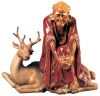
lohan01.jpgLohan: PINDOLA2709 viewsLegend has it that the first portraits of the 18 Lohans were painted by a Buddhist
monk Guan Xiu, in 891 A.D. Guan Xiu lived in Chengdu, the capital of a small
kingdom, the Former Shu, formed at the decline of the Tang Dynasty in what is
today's Sichuan Province. He was adept at the scholarly pursuits of painting,
calligraphy and poetry.
|
|
|
|






















 Social Bookmarks


