 Most viewed Most viewed |

buddha_life_02.gifQueen Mahamaya's Dream6046 viewsQueen Mahamaya's Dream
|
|

budrelig.pdfBuddhism as a Religion6022 viewsThe contents of this popular publication are a simple exposition of Buddhism as a modern way of life. This highly qualified Sri Lankan Buddhist scholar has a special gift of interpreting the Buddha's Teachings for people from every walk of life. His whole approach to the exposition of the Dhamma is governed by his deep concern for giving the ancient teachings a contemporary relevance, and has a meaning that cuts across the boundaries of time, space, race, culture and even religious beliefs.
|
|
chandew.pdfThe Sweet Dews of Ch'an6018 viewsReverend Cheng Kuan
Ch'an or Zen is the outcome of meditation. There are two 'right'or 'highest' purposes of Ch'an. The first purpose is to achieve Dhyana. Dhyana is a combination of relaxation, concentration and calmness or tranquility. The second purpose is, using your very composed and tranquil mind, to observe clearly all the dharmas or phenomena externally and internally. As an outcome of Dhyana, you will be able to observe these phenomena very clearly because your mental mirror is very clear, for there are no more disturbances to veil it. Out of these observations will come Transcendental Wisdom, which in Sanskrit is called Prajna.
|
|

z-stupa02.jpgStupa015992 viewsTibetan Buddhist Art Work: Stupa01
|
|
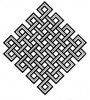
knot01.jpgSacred Knot015980 viewsTibetan Buddhist Art Work: Sacred Knot01
|
|
lamdre.pdfLamdre - Dawn of Enlightenment5943 viewsThis is a series of lectures on the precious Lamdre teachings of the Sakya tradition of Tibetan Buddhism, given by Lama Choedak Yuthok. Lamdre is a complete path to enlightenment. The extraordinary qualities of Lamdre teachings are based on the Hevajra Tantra. They were initially received by the 7th century Indian Mahasiddha Virupa, who founded the lineage and transmitted the teachings to a line of disciples in India. Virupa also wrote pith instructions known as Vajragatha.
|
|
abhistudy.pdfAbhidhamma Studies (Buddhist Psychology)5929 viewsThe content of these studies is rather varied: they include philosophical and psychological investigations, references to the practical application of the teachings concerned, pointers to neglected or unnoticed aspects of the Abhidhamma, textual research etc. This variety of contents serves to show that wherever we dig deep enough into that inexhaustible mine, the Abhidhamma literature, we shall meet with valuable contributions to the theoretical understanding and practical realization of Buddhist doctrine.
|
|
damachak.pdfDhammacakkappavattana Sutta5862 viewsVen. Mahasi Sayadaw
The First Discourse of the Buddha, namely the Dhammacakkappavattana Sutta, commonly known as the Great Discourse on the Wheel of Dhamma. This is a series of discourses on the Dhammacakka Sutta by the late Venerable Mahasi Sayadaw, a Questioner at the Sixth Buddhist Council in Myanmar, (Burma) 1954. Translated by U Ko Lay.
|
|
01_how_can_we_read.pdfReading the Suttas: How Can We Read?5839 viewsIntroduction. What is a sutta?
How would we read the Nikayas if we were academics?
How would we read the Nikayas if we were practitioners?
A study of the Kalama Sutta. This sutta is one of the most quoted in Western Buddhism, and the most quoted part of it is the section beginning:
“Kà là mas, for you to doubt, to be uncertain; uncertainty has arisen in a doubtful matter. Do not rely upon what has been acquired by repeated tradition; nor upon lineage; nor upon rumour; nor upon what is handed down in the teachings; nor upon logic; nor upon inference; nor upon a consideration of reasons; nor upon a delight in speculation; nor upon appearances; nor upon respect for your teacher. Kà là mas, when you know for yourselves: These things are unskilful; these things are blameable; these things are censured by the wise; undertaken and observed, these things lead to harm and suffering,’ then abandon themâ€.
|
|
dmind-wmind.pdfDharma Mind, Worldly Mind5835 viewsThe first part of the book tells us what we need to put in place for complete Dharma practice - the Eightfold Path, going for refuge, and the Bodhisattva spirit. In the second half the book shows us how to turn those requisites into a genuine living practice that embraces the whole of our life thus surely leading to the profound transformation that we all desire.
|
|
| 1212 files on 122 page(s) |
 |
|
|
11 | |
|
|
|





















 Social Bookmarks


