 Most viewed Most viewed |

only_help.pdfOnly We Can Help Ourselves4513 viewsKamma is an interesting subject because it concerns everyone and there are many different aspects of it. There are many natural laws that govern our lives but the most important is the law of kamma-vipaka. In a discourse (A.N. 6.63) the Buddha said, Intention, monks, is kamma I say. Having willed, one acts through body, speech and mind. This means that intentional action is kamma, and vipaka is the result or effects of it. The result may ripen immediately, later in this life or in a future life.
|
|
jotleeds.pdfSnow in the Summer4507 viewsThis book is a compilation of extracts from letters written by Sayadaw U Jotika, a Burmese Buddhist monk, to his Western students ten to fifteen years ago. These letters have been collated under the topics indicated by these chapter headings: Mind, Mindfulness and Meditation; Solitude; Parental Love and Guidance; Life, Living and Death; Learning and Teaching; Value and Philosophy; Friendship, Relationships and Loving-kindness.
|
|
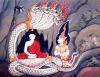
buddha_life_15.jpgMucalinda, the Serpent King4496 viewsMucalinda, the Serpent King
|
|
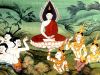
buddha_life_14.jpgThe Daughters of Mara4491 viewsThe Daughters of Mara
|
|
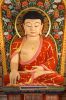
01buddha-portrait01.jpgChinese Buddha Statue4476 viewsImage of Modern Chinese Buddha Statue
|
|
screenrahula.pdfRahula Leads the Way4469 viewsThe Adventures of Leo: a delightful Buddhist story that describes the adventures the little boy Leo has when he meets the young monk Rahula. Thanks to Rahula's monk's training and good sense, Leo learns how to be the best little boy possible.
|
|
TowardsAnInnerPeace-VF11p.pdfTowards an Inner Peace4437 viewsIn Towards an Inner Peace, Venerable Dhammajiva instructs yogis to progress by developing continuous mindfulness and deep concentration. He takes yogis through a journey, which progressively leads to the development of vipassana insights. His step by step instructions provide an invaluable theroretical basis to confront and embrace the challenges along the path to attain a state of path and fruition consciousness.
|
|
a_taste_of_salt(2).pdfA Taste of Salt4436 viewsThe Sutta Pitaka was written down in the Pali language over 2,000 years ago. The Sutta Pitaka is made of five collections of suttas; the Digha Nikaya, the Majjima Nikaya, the Samyutta Nikaya, the Anguttara Nikaya, and the Khuddaka Nikaya. These texts remain the most complete record of early Buddhist teachings. The suttas fill thousands of pages, and it is a daunting task for most readers to read through the many volumes. A Taste of Salt draws 350 pages containing the central teachings of the Buddha from the roughly 5,000 pages of the Sutta Pitaka. The purpose of this collection is to make these essential texts more accessible to meditators and students of Buddhism.
|
|
vandana.pdfBhavana Vandana - Book of Devotion4428 viewsThe purpose of this book is manifold. One is to teach the users of this Vandana book how to pronounce Pali words correctly. By the daily repetition of these Pali verses and Suttas people can learn the Pali pronunciation without much effort. Secondly we intend to teach people the Pali language without much toil. Therefore we made one half of our chanting in English, so people learn the meaning of what they chant in Pali and later on they can compare the English with the Pali. Thirdly, we intend to teach people Dhamma through devotional service. In order to fulfill all these purposes we decided to include certain Suttas which are not normally used in Viharas for vandana service.
|
|
Things_as_They_Are.pdfThings As They Are4424 viewsIn order to be principled and methodical in your training, keep your awareness constantly with the body. Keep mindfulness focused there and use wisdom to investigate within the sphere of the body. The more you investigate the body until you understand it clearly, the more sharply you will understand the affairs of feelings, memory, thought-formations, and consciousness, because all these things are whetstones for sharpening wisdom step by step. It's the same as when we bail water out of a fish pond: the more water we bail out, the more clearly we'll see the fish. Or as when clearing a forest: the more vegetation we cut away, the more space we'll see. When you use wisdom to contemplate in this way, the currents of the heart will become plain...
|
|
| 1212 files on 122 page(s) |
 |
|
|
21 | |
|
|
|





















 Social Bookmarks


