 Most viewed Most viewed |

07_tara.jpgThe 21 Taras (07)3211 viewsThe 21 Taras [Tibetan style] (Tibetan, Sgrol-ma)
It was not until the adoption of the Yogachara system, taught by Asanga in the fourth century AD, that the feminine principle began to be venerated in Mahayana Buddhism. Around the sixth century, the goddess Tara was considered as a Sakti of Avalokitesvara (sometimes as his wife).
|
|

Path_of_Freedom_Vimuttimagga.pdfThe Path of Freedom / Vimuttimagga 3202 viewsThe work is compiled in accordance with classical Buddhist division of the path into the three stages of virtue, concentration, and wisdom, culminating in the goal of liberation. It is widely believed that the Vimuttimagga may have been the model used by Buddhaghosha to compose his magnum opus, the Visuddhimagga (Path of Purification), several centuries later. The older work is marked by a leaner style and a more lively sense of urgency stemming from its primarily practical orientation.
|
|

12white-heart-lotus.jpgLotus Heart3198 viewsLotus Heart
|
|
04Interview_-_What_to_Report.pdfWhat to Report in an Interview3197 viewsOnce the beginner is established in the basic techniques, students are then required to report their experience to the teacher in a formal interview throughout the retreat. The interview is the basis for the relationship between the teacher and the student. It is crucial for the development of Vipassana meditation as it is where the meditator reports his or her experience and can be guided and given further instructions if need be by the teacher.
|
|
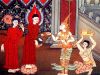
buddha_life_22.jpgOn Alms Round in Kapilavastu3193 viewsOn Alms Round in Kapilavastu
|
|
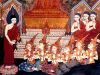
buddha_life_23.jpgThe Buddha's Father was cremated3193 viewsThe Buddha's Father was cremated
|
|
06_satipatthana_sutta_02.pdf02 Satipatthana Sutta3190 viewsDuring this course we have looked at how different interpretative communities read the Nikayas. Among these are contemporary communities formed by the experience of modernity, practitioners who are attempting to apply the teachings found in the Nikayas to their daily lives in the contemporary world. Locating ourselves within such a community, we can see that our reading is a form of practitioner criticism. We have sought to make sense of this alien literature firstly by acknowledging that it is not a literature at all, but a collection of oral performances. We have examined how these performances are both made up of and linked by patterns of repetition lists of lists within lists. The lists function like tables in individual databases, and the teaching as a whole - the dhamma - functions as a relational database which exists, not within any given sutta, but as a network of relationships which underlies and unites all the suttas.
|
|
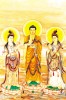
Amithaba008.jpgAmithabha Buddha083190 viewsAMITABHA: Buddha of Boundless Light of the Western Paradise
|
|
upanisa_sutta.pdfTranscendental Dependent Arising3186 viewsBhikkhu Bodhi
Dependent Arising (paticcasamuppada) is the central principle of the Buddha's teaching, constituting both the objective content of its liberating insight and the germinative source for its vast network of doctrines and disciplines. So crucial is this principle to the body of the Buddha's doctrine that an insight into dependent arising is held to be sufficient to yield an understanding of the entire teaching. In the words of the Buddha: He who sees dependent arising sees the Dhamma; he who sees the Dhamma sees dependent arising.
|
|

Bhutan0016.jpgBhutan - Buddhist Himalayan Kingdom (07) 3177 viewsIn 2005 the Australian monk Ven S Dhammika was invited to the remote Himalayan kingdom of Bhutan and spent ten days visiting the countries monasteries, shrines and temples. We present some of the pictures he took while in this rarely visited land and hope you enjoy them.
|
|
| 1212 files on 122 page(s) |
 |
|
|
37 | |
|
|
|























 Social Bookmarks


